



It’s just an Erlenmeyer flask; do we really need to spend time researching its selection? That question often lingers until something goes wrong in the middle of a critical process.
A cracked flask during handling. Unexpected contamination in a sterile batch. Or worse, compromised results after hours of work. These are not rare accidents. They are often the result of choosing the wrong material.
From high-temperature chemical reactions to sensitive cell culture workflows, every application demands a material that performs without compromise.
That is where the difference between Glass, Polycarbonate (PC), and PETG becomes crucial.
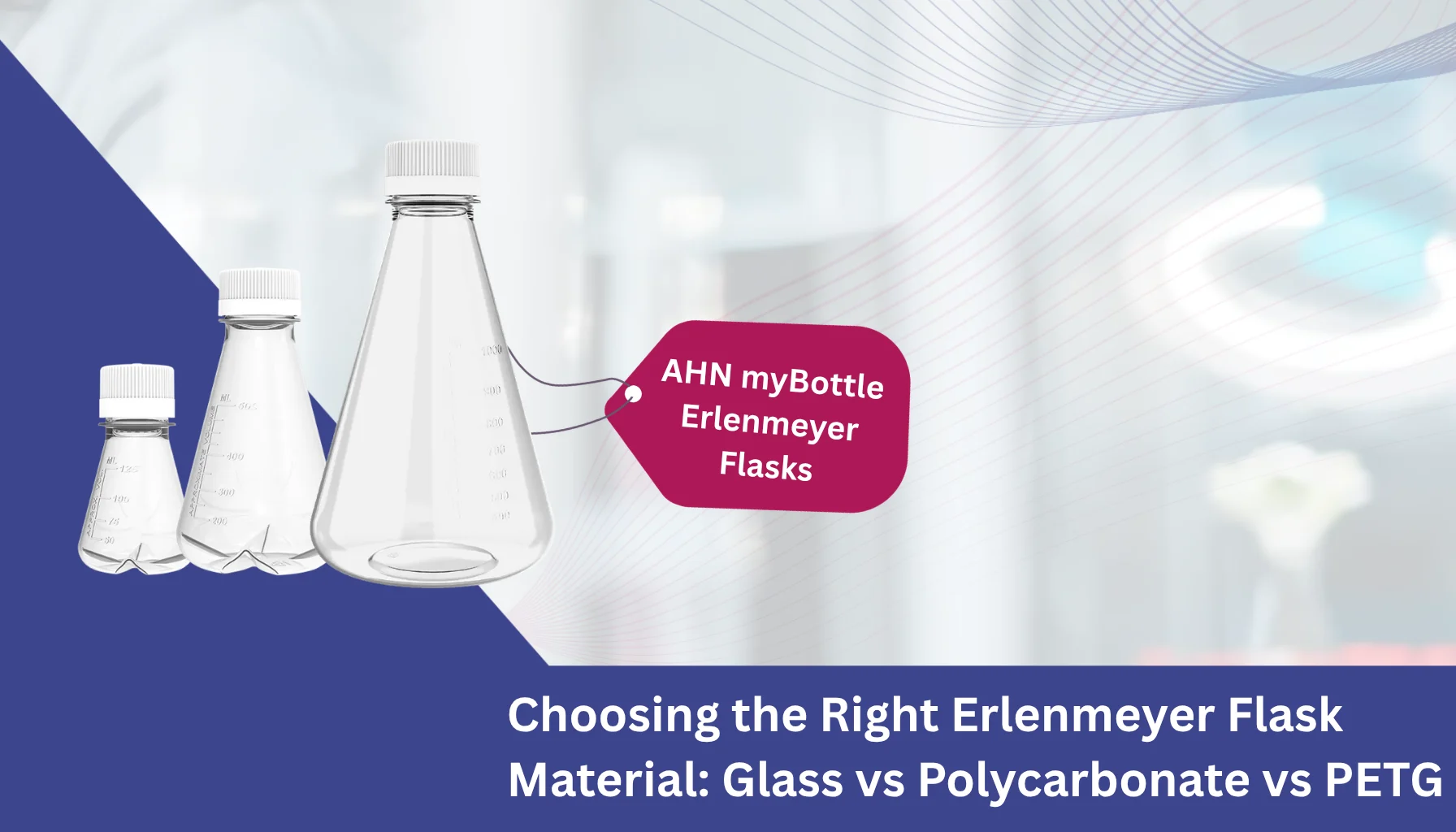
Each material responds differently under pressure, heat, and sterile conditions. Modern solutions like AHN® myBottle® Erlenmeyer Flasks are built with this reality in mind. They offer both PETG and PC variants designed for real lab challenges.
Because the right flask does not just hold your sample. It protects your process, your time, and your results. Let’s break down these materials and find the right fit for your lab.
Overview of Common Flask Materials
Different flask materials serve very different lab environments. Glass is the traditional choice for chemical resistance and high heat. Polycarbonate offers durability and reusability in busy lab setups. PETG focuses on sterility and convenience, especially in biopharma workflows. Each material fits a specific purpose. Understanding that purpose is key to better performance.
Glass Erlenmeyer Flasks
Glass flasks have been a laboratory staple for decades. They are trusted for their stability and chemical resistance.
Key Features:
- Glass handles aggressive chemicals without degradation or interaction.
- It remains stable under high temperatures and repeated sterilization cycles.
- Autoclaving glass is straightforward, making it highly reusable.
Best For:
- Glass flasks are ideal for chemical laboratories and analytical work.
- They perform well in high-temperature reactions and harsh environments.
Limitations:
- Glass is fragile and prone to breakage under impact.
- It is also heavier, making handling slightly slower and more complicated.
In modern labs, safety and efficiency matter more than ever. That is where alternatives begin to stand out.
AHN Erlenmeyer Polycarbonate (PC) Flasks
Polycarbonate flasks bring durability into the equation. They are built for labs where handling is frequent and demanding.
Key Features of AHN® myBottle Erlenmeyer Flasks (PC)
- PC flasks are highly impact-resistant and built for long-term use.
- They offer excellent transparency for clear and accurate sample observation.
- They are autoclavable, making them ideal for repeated sterilization cycles.
- The PC variant is engineered for reliability and repeated use.
- It withstands temperatures from -80°C to 121°C for 15 mins with ease.
- They are available in both baffled and flat-bottom designs.
- Baffled flasks enhance mixing efficiency during shaking applications.
- They come with vented and non-vented caps for flexible usage.
- Vented caps allow gas exchange, while non-vented caps ensure secure sealing.
- Manufactured in a cleanroom environment for consistent quality and purity.
- Offered in a wide volume range to suit diverse lab requirements.
- Their leakproof and shatterproof design enhances both safety and efficiency.
Best For:
- They are ideal for routine lab workflows requiring consistent reuse.
- Handling-heavy environments benefit from their rugged design.
- Suitable for applications involving frequent sterilization cycles.
- Perfect for labs prioritizing durability and long-term cost efficiency.
- Well-suited for mixing, media preparation, and sample storage.
- Ideal for shaker-based applications, especially with baffled designs.
- A reliable choice for labs needing both performance and safety.
Limitations:
- Polycarbonate offers slightly less chemical resistance.
- Some solvents may affect long-term performance.
If your lab prioritizes durability with reusability, PC is a strong choice. It strikes a balance between strength and practicality.
AHN Erlenmeyer PETG Flasks
PETG flasks are designed for modern, sterile environments. They simplify workflows where contamination risks must be minimized.
Key Features of AHN® myBottle Erlenmeyer Flasks (PETG):
- These flasks are often pre-sterilized and ready for immediate use.
- They provide excellent visibility for cell culture monitoring.
- Manufactured in a Class 100K cleanroom for superior cleanliness and consistency.
- Sterilised by gamma irradiation, making them ready for immediate use.
- Made from USP Class VI material with low leachables and extractables.
- This ensures maximum sample purity and reliability.
- Certified RNase/DNase-free, nonpyrogenic, and noncytotoxic.
- Ideal for sensitive cell culture and biopharma applications.
- Crystal clear PETG construction offers excellent visibility and easy monitoring.
- Lightweight and break-resistant design enhances handling safety.
- Equipped with vented caps featuring a hydrophobic 0.2μm PTFE filter.
- Allows continuous gas exchange while maintaining sterility.
- Available in volumes ranging from 125 mL to 3 litres.
- Leakproof design ensures secure storage, mixing, and transport of samples.
Best For:
- PETG is perfect for cell culture and biopharma applications.
- It supports media preparation, mixing, and storage tasks efficiently.
Limitations:
- PETG is not suitable for high-temperature applications.
- It is generally used as a single-use solution.
- For labs focused on sterility and speed, PETG is unmatched.
Material Comparison Table
| Parameter | Glass | Polycarbonate (PC) | PETG |
| Sterility | Requires in-house sterilization before use | Autoclavable for repeated sterilization | Pre-sterilized, ready-to-use |
| Operational Readiness | Additional prep time required | Requires sterilization cycles | Immediate use, no prep needed |
| Reusability | Reusable but prone to breakage over time | Highly reusable with durability | Designed for single-use to eliminate contamination risks |
| Chemical Resistance | Can degrade with repeated harsh chemical exposure | Moderate resistance to chemicals | Suitable for limited chemical exposure |
| Durability & Handling | Fragile, high breakage risk | Highly durable, impact-resistant | Break-resistant and easy to handle |
Each material serves a distinct purpose. The right choice depends on your application priorities.
Choosing the Right Erlenmeyer Flask Based on Application
Let’s simplify the decision-making process. For cell culture and bioprocessing, PETG is the preferred choice. It ensures sterility and reduces preparation time significantly. For chemical handling and high-temperature work, glass is ideal. Its resistance and stability make it highly reliable.
For routine lab operations, polycarbonate offers the best balance. It combines durability, reusability, and ease of handling. If your workflow involves multiple steps and frequent handling, consider Polycarbonate (PC). If sterility and speed matter most, PETG is the smarter option.
AHN® myBottle® Erlenmeyer Flasks simplify this decision further. With both PETG and PC variants, they adapt to your exact needs. Features like graduated markings ensure precise measurements every time. Their leakproof construction protects both samples and users.
Conclusion
Material selection is not just a technical choice. It directly affects lab efficiency, safety, and results. Glass, PC, and PETG each serve a unique purpose. Understanding their strengths helps you avoid costly mistakes.
For modern labs, flexibility is key. That is where AHN® myBottle® Erlenmeyer Flasks deliver real value. Match the material to your application. And your workflow will become faster, safer, and more reliable.