



PCR reactions deal with tiny volumes. Often just a few microliters. They might seem small, yet for a molecular biologist, they can mean valuable time, high costs, and sometimes even critical samples.
They can confirm the presence of a pathogen. They can validate months of genetic research. Sometimes, they even determine the direction of an entire study.
Naturally, researchers pay close attention to protocols. Primers are optimized. Polymerases are carefully selected. Thermocycler settings are adjusted with precision.
But there is one detail that quietly influences every PCR reaction. The PCR consumables hold the sample. PCR tubes, strips, and plates may look simple. In fact, many appear almost identical on the surface. However, the design, material purity, and structural quality of these plastics can directly influence experimental performance.
A poorly designed tube can slow heat transfer. Low-purity plastic may introduce contaminants. Weak sealing can cause evaporation and sample loss. These issues may seem small individually, but together, they can compromise reproducibility and affect valuable results.
That is why selecting the right PCR consumables is more important than you think.
The following tips will help researchers choose the right PCR consumables for their experiment that support reliable, consistent, and high-quality molecular biology workflows.
1. Start with Certified Purity
PCR is highly sensitive to contamination. Even trace biological material can interfere with amplification reactions. DNases degrade nucleic acids, RNases destroy RNA templates, and PCR inhibitors can block polymerase activity. Such contamination often leads to failed or unreliable results.
For this reason, PCR consumables must offer certified purity. AHN PCR consumables are free from DNase, RNase, human DNA, PCR inhibitors, and endotoxins, meeting strict purity standards. Each production lot is handled under sterile manufacturing conditions. This ensures that the plastics themselves do not compromise experimental results.
2. Evaluate Wall Thickness for Efficient Heat Transfer
Uniform wall thickness plays a critical role in PCR performance. During the Polymerase Chain Reaction, the reaction mixture must quickly reach the required temperature in each cycle. If PCR tubes have uneven walls, heat does not transfer evenly. Thinner areas heat up faster, while thicker sections transfer heat more slowly. This creates small temperature differences within the reaction mixture.
As a result, key steps like DNA denaturation or primer annealing may not occur efficiently, which can reduce amplification efficiency or affect result consistency. High-quality PCR consumables are designed with uniform thin walls to ensure fast, even heat transfer and reliable PCR performance.
High-quality PCR consumables address this challenge with extra-thin and uniform wall thickness. This allows heat to move efficiently between the instrument and the sample. AHN myTube® PCR Tubes are designed with this principle in mind. Their thin and uniform walls promote optimal heat transfer while helping reduce overall cycle time. As a result, thermocycling becomes more efficient and consistent.
3. Consider Tube Geometry for Better Sample Recovery
PCR reactions typically use very small liquid volumes. Even a small amount of retained liquid can represent a meaningful sample loss.
In conventional tubes, flat or poorly designed bottoms may trap droplets along the edges. These droplets can be difficult to reach with pipette tips. A well-designed tube geometry solves this problem.
The V-shaped bottom used in AHN myTube® PCR Tubes concentrates the reaction mixture toward the center of the tube. This design allows easier access during pipetting and improves sample recovery after reactions. By using AHN mytube®, PCR tube laboratories can prevent sample loss and protect valuable samples during DNA or RNA amplification while improving overall handling accuracy.
4. Ensure Optical Clarity for qPCR Applications
Real-time PCR adds another layer of precision to molecular experiments. Instead of simply producing amplified DNA, the reaction is monitored as it happens through fluorescence signals.
As amplification progresses, instruments detect these signals and translate them into measurable data. Depending on the system, the signal may be read through the bottom of the tube or directly through the cap.
And for that reason, the optical quality of PCR plates and tubes becomes extremely important.
If the plastic is not sufficiently transparent, fluorescence signals may weaken or scatter before reaching the detector. This can introduce noise into the data and affect the accuracy of the results.
High-transparency PCR consumables help prevent these problems by allowing optical signals to pass through cleanly and consistently.
AHN mytube® PCR and qPCR Strips are designed with this requirement in mind. Their highly transparent material supports reliable signal detection through the tube bottom, while ultra-clear caps enable accurate optical readings through the top when required.
With improved optical clarity, researchers can obtain cleaner fluorescence data and maintain reliable real-time PCR measurements throughout the experiment.
5. Choose the Format That Matches Your Workflow
Different laboratory workflows demand different PCR formats. Choosing the appropriate format improves efficiency and simplifies daily laboratory operations.
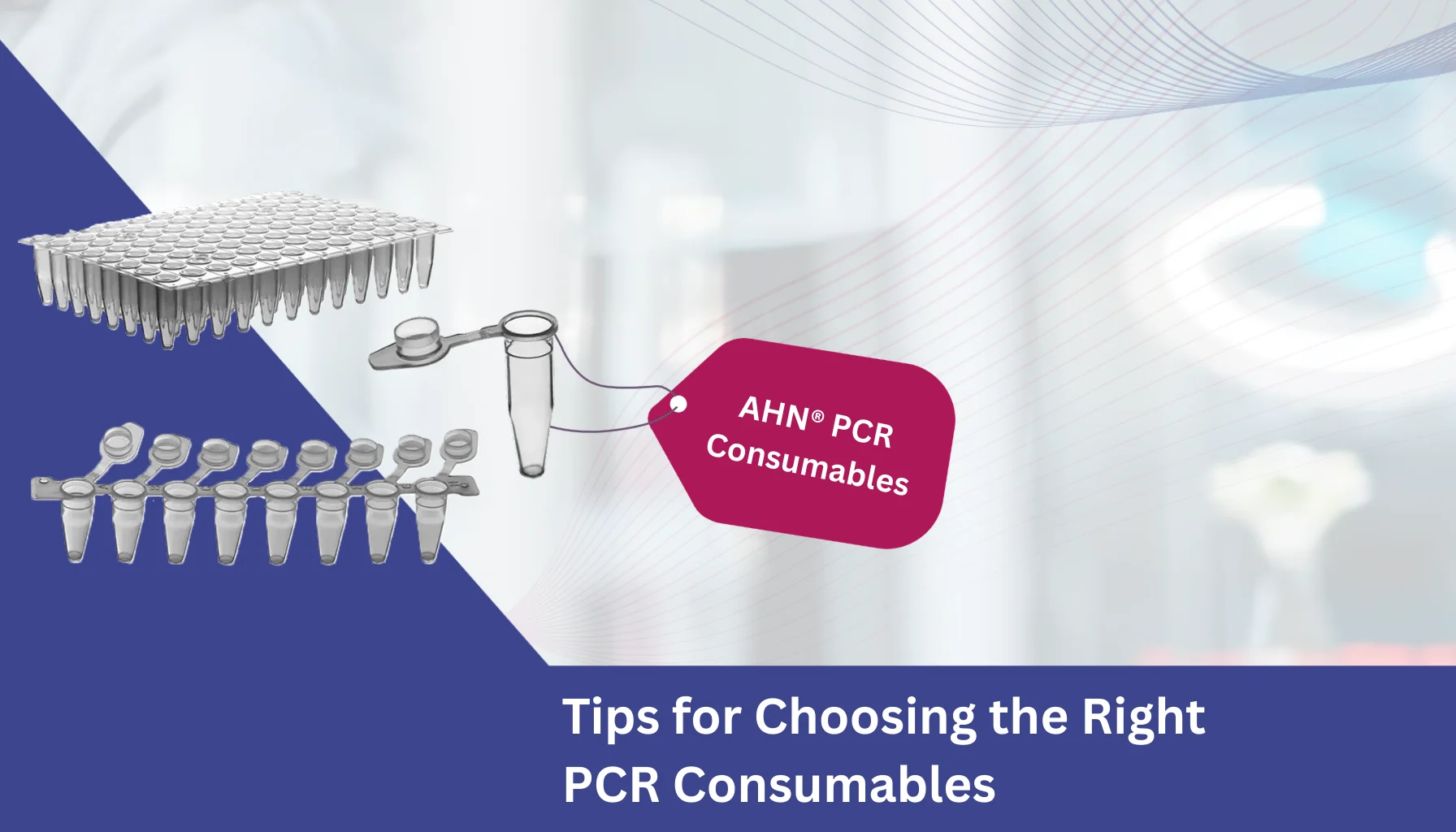
AHN myTube® PCR Tubes
- High-purity material: Made from premium raw materials that meet strict purity standards. The tubes offer excellent chemical resistance and withstand high mechanical stress, helping prevent contamination and sample loss.
- Better sample recovery: The V-shaped bottom design helps collect samples more efficiently. This ensures easier recovery after PCR processes.
- Faster heat transfer: Extra-thin, uniform tube walls allow efficient thermal transfer. This supports consistent PCR performance and can help reduce cycle time.
- Clear optical measurement: The tubes have high transparency. This makes them suitable for qPCR applications where the optical signal is read from the bottom.
- Certified purity: Tested and certified free from DNase, RNase, human DNA, PCR inhibitors, and endotoxins. This ensures reliable and reproducible results.
- Strong centrifugation performance: Compatible with centrifugation speeds of up to 6000 × g without compromising tube integrity.
- Convenient cap design: The ergonomic flat cap allows easy one-handed opening and closing, making daily lab work simpler and more secure.
- Autoclavable: Suitable for sterilization at 121°C for 15 minutes, supporting safe reuse when required.
- Sterile manufacturing: Each lot is produced under strict sterile conditions to maintain consistent quality and laboratory safety.
AHN myTube® PCR and qPCR Strip Tubes
Reliable PCR results require consistent heat transfer, clear optical detection, and contamination-free handling. AHN myTube® PCR strip tubes are designed to support accurate amplification and dependable laboratory workflows.
Key Features
- Optical measurement: High-transparency strips allow qPCR signal detection from the bottom. Ultra-clear caps are available for systems reading fluorescence through the cap.
- Compatibility:
- 0.1 mL strips for fast thermocyclers requiring low-profile tubes
- 0.2 mL strips for standard thermocyclers requiring regular-profile tubes
Compatibility charts are available on request.
- 0.1 mL strips for fast thermocyclers requiring low-profile tubes
- Efficient heat transfer: Extra-thin, uniform tube walls support optimal thermal transfer and reduced cycle time.
- Sterile and pure: Manufactured under strict sterile conditions and certified free from DNase, RNase, human DNA, PCR inhibitors, and endotoxins.
- Reliable performance: Evaporation rate below 5% helps maintain reproducible results.
- Autoclavable: Sterilization compatible at 121°C for 15 minutes.
- Available formats: 0.1 mL and 0.2 mL PCR strip tubes, with separate or attached caps.
AHN myTube® PCR Plates for High Throughput Experiments
When experiments involve dozens or hundreds of reactions, PCR plates become the most practical option.
AHN myTube® PCR Plates offer multiple configurations that support a variety of laboratory workflows. Researchers can select non-skirted, semi-skirted, or fully skirted plates depending on their instrument requirements.
AHN myTube® plates are also available in several volumes, including 0.1 mL, 0.2 mL, and 40 µL formats for 384-well applications.
Additional features further improve usability. Alphanumeric well coding simplifies sample identification, while raised well rims ensure secure sealing with adhesive films to prevent evaporation.
6. Do Not Overlook Sealing Quality
Proper sealing plays an important role in maintaining reaction stability. During PCR cycling, even small amounts of evaporation can change reagent concentrations. This can reduce amplification efficiency and affect experimental reproducibility. Reliable sealing membranes prevent these issues.
AHN myPlate® PCR and qPCR sealing membranes provide strong adhesive sealing with evaporation rates below 5%. Multiple membrane options support different laboratory needs.
Standard membranes are suitable for routine PCR applications. Optical membranes enable fluorescence detection during real-time PCR. Aluminium membranes can also be used for storage or pierceable access.
These membranes operate within a wide temperature range from -40 to 120 degrees Celsius, ensuring stability during PCR workflows.
7. Broad instrument compatibility
Choose PCR consumables that are validated for use with a wide range of thermocyclers and qPCR systems. AHN myTube® PCR consumables are compatible with instruments from leading manufacturers such as Thermo Fisher Scientific, QIAGEN, Biometra, and Amersham. A detailed compatibility chart is available for reference.
The Takeaway
PCR success depends on many variables. Primers and Polymerases matter, but plastic consumables matter too. The right PCR plastics improve reliability. They protect samples from contamination.
They also enhance workflow efficiency. High-purity materials reduce experimental errors. Optimized designs improve heat transfer and recovery. Proper sealing prevents evaporation losses.
AHN PCR consumables combine these essential qualities. From PCR Tubes 0.2 mL to PCR strips, PCR plates, and sealing membranes, AHN Biotechnologie GmbH designs each product to support reliable molecular workflows. Choosing the right PCR plastic may seem like a small decision, but it can make a significant difference in experimental success.