


In the midst of all the equipment in a busy laboratory, it is often the smallest pieces of equipment that have the largest impact. One such piece of equipment is the centrifuge. It is responsible for fast sample separation, microtube handling, and regular spinning while saving space on your lab bench.
However, this piece of equipment is not perfect. There are a number of things that might hinder you from achieving maximum performance. Luckily, the majority of the mistakes can be avoided. Here are seven of them and how to overcome each.
1. Rotor imbalance: why is your centrifuge shaking?
This is probably the most common issue. If the tubes aren’t placed properly, or their contents differ a lot in weight, the rotor gets loaded unevenly. You’ll notice heavy vibration, odd noises, or a run that stops partway through.
What helps:
- Place tubes directly opposite each other.
- Match tubes by weight and volume.
- Make sure every tube is fully seated.
- Never run an unevenly loaded rotor.
Imbalance detection is a handy safety net. The CAPPRondo CR-1512 has it built in, so it can flag the problem during a run.
2. Wrong tube size or adapter
We’ve all been there: the tube just doesn’t sit right in the rotor. A poor fit leads to bad positioning and unreliable runs.
What helps:
- Check which tube sizes your rotor supports before you start.
- Use adapters for smaller tubes.
- Make sure tubes sit snugly, with no wobble.
- Never force a tube into a slot it wasn’t made for.
The CR-1512 comes with a pre-installed rotor for 12 × 2.0 mL tubes, plus adapters for 0.1/0.2 mL and 0.4/0.5 mL tubes, so it covers the usual microtube sizes.
3. Mixing up RPM and RCF
They sound similar, but they aren’t the same thing. RPM is how fast the rotor spins. RCF is the force your sample actually experiences. Choosing the wrong one can change your results.
What helps:
- Follow the conditions in your lab protocol.
- Know the difference between RPM and RCF.
- Stay within the maximum speed of your tubes and rotor.
It’s easier when your centrifuge lets you set either one directly. The CR-1512 runs from 500 to 15,000 RPM, with a maximum RCF of 15,596 × g.
4. Controls that get in the way
When you’re processing lots of samples, nobody wants to click through menus just to run a simple spin. Complicated controls waste time.
What to look for:
- A simple, intuitive interface
- Easy access to speed and timer settings
- A short-spin function
- A clear display
The CR-1512 has a backlit LCD, a one-touch short-spin, a countdown timer and last-run memory, so everyday use stays quick.
5. Keeping conditions consistent from run to run
Reproducible results depend on repeating the same conditions. Typing in settings by hand every time invites mistakes, especially if you switch between protocols often.
What helps:
- Stick to clearly defined protocols.
- Keep RPM or RCF and time settings consistent.
- Check your settings before every run.
- Use a centrifuge that lets you recall previous settings.
Last-run memory takes care of that last point. The CR-1512 remembers your previous settings, so repeat runs are one less thing to enter.
6. Too much noise, not enough bench space
Labs are crowded. A bulky or noisy centrifuge makes the whole space less pleasant to work in.
What to consider:
- Size and footprint
- Noise during operation
- Weight
- Motor design and upkeep
The CR-1512 is compact at 262 × 230 × 131 mm. It uses a brushless DC motor and runs below 60 dB, which suits labs short on space.
7. Skipping safety and routine checks
Even a small instrument deserves proper care. Ignoring unusual behavior is how small problems become bigger ones.
What helps:
- Close the lid securely before every run.
- Inspect the rotor and tube holders regularly.
- Look for visible damage before you start.
- Follow the manufacturer’s instructions.
- Stop the run if you notice strange vibration or noise.
A lid lock and imbalance detection add extra protection, and the CR-1512 has both.
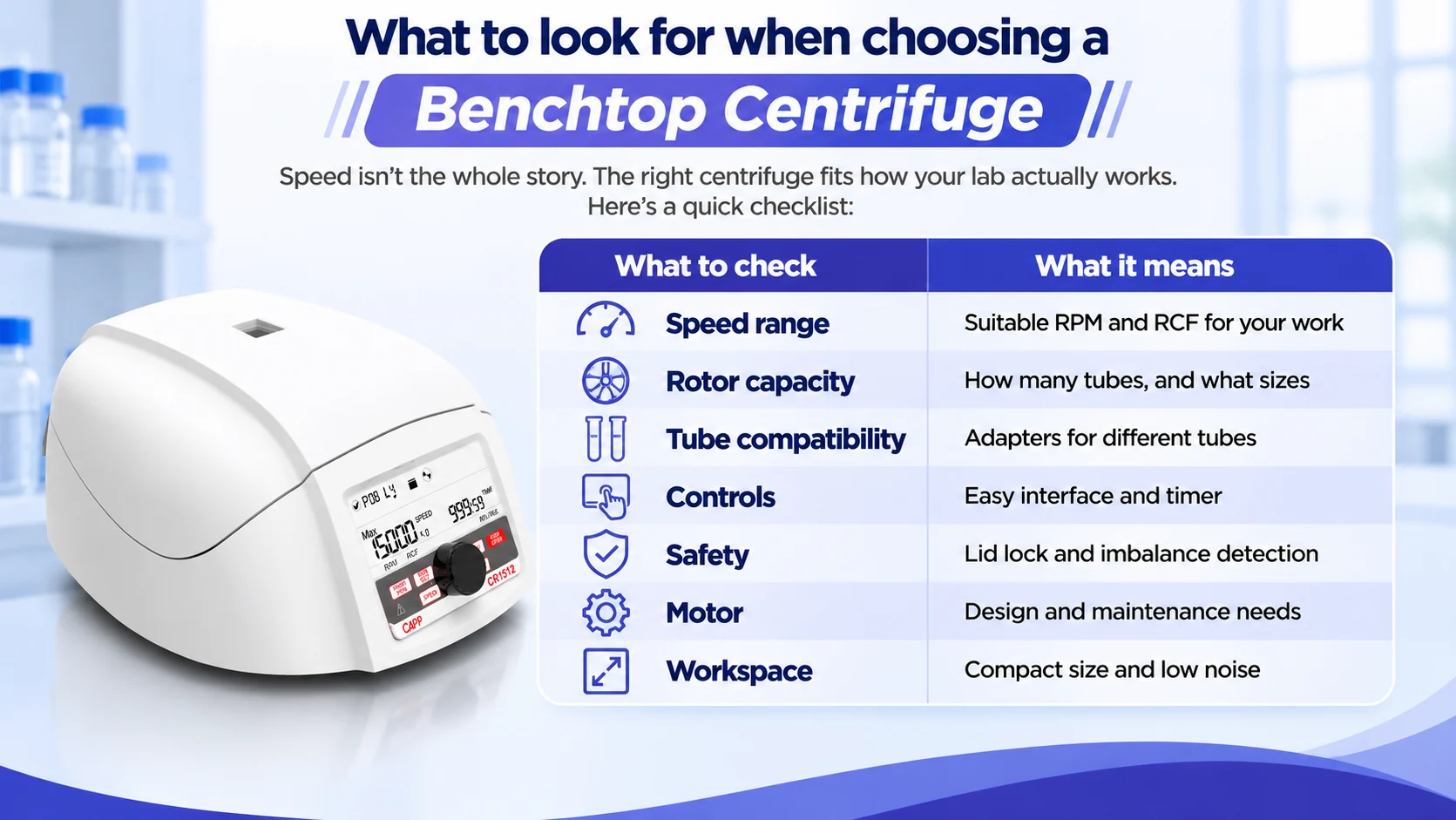
What to look for when choosing a benchtop centrifuge
Speed isn’t the whole story. The right centrifuge fits how your lab actually works. Here’s a quick checklist:
| What to check | What it means |
| Speed range | Suitable RPM and RCF for your work |
| Rotor capacity | How many tubes, and what sizes |
| Tube compatibility | Adapters for different tubes |
| Controls | Easy interface and timer |
| Safety | Lid lock and imbalance detection |
| Motor | Design and maintenance needs |
| Workspace | Compact size and low noise |
If your lab works with different formats, optional rotors help too. The CR-1512, for example, supports an optional 2 × 8 PCR strip rotor.
Final thoughts
A benchtop centrifuge may be small, but it’s used constantly. Avoiding imbalance, matching your tubes to the rotor, and choosing the right speed settings go a long way toward smoother, more consistent work.
AHN Biotechnologie offers the CAPPRondo CR-1512 High-Speed Benchtop Centrifuge, which combines a brushless DC motor, adjustable speed, flexible tube compatibility, imbalance detection, and a compact body. Good workflows start with equipment that keeps everyday tasks simple.
Explore the CAPPRondo Benchtop Centrifuge and see how much easier routine spins can be.
Frequently Asked Questions
1. How does rotor radius affect RCF?
A bigger radius means more force at the same RPM. So when you move a protocol to a different centrifuge, match the RCF, not just the RPM.
2. Can I spin PCR strips and individual microtubes in the same centrifuge?
Yes, as long as you have the right rotor for each. The CAPPRondo CR-1512 takes 12 × 2.0 mL tubes and has an optional 2 × 8 PCR strip rotor.
3. Why do my pellets look different from run to run?
Usually it’s a small change somewhere: RCF, spin time, sample volume, tube position or the sample itself. Keep your settings identical and your tubes balanced, and results get much more consistent.
4. Why does a brushless DC motor matter?
There are no carbon brushes to wear out, so there’s less motor maintenance and steadier performance, even with frequent runs.
5. What should I check before using a high-speed centrifuge on sensitive samples?
Look at the maximum RCF, rotor and tube compatibility, acceleration and how stable your sample is. Also check temperature needs, since not every benchtop centrifuge has refrigeration.


