


Choosing a centrifuge starts with one simple question. What does your lab actually centrifuge every day? Not every workflow needs maximum speed. Not every sample needs a large rotor. And not every lab needs the same flexibility.
That is where choosing becomes important. A mini centrifuge suits fast, small-volume workflows. A micro centrifuge supports routine microtube processing. A universal centrifuge handles broader sample formats.
The right choice depends on your workflow, capacity, and control. So, let’s make that decision easier and explore several options by AHN Biotechnologie.
Start With the Sample, Not the Centrifuge
Before comparing specifications, look at your samples. Are you working with microtubes?
Do PCR strips appear frequently in your workflow? Are larger tubes part of your daily processing? Your answers immediately narrow the options.
Speed also matters, but it is not everything. Rotor compatibility can matter just as much. So can programming, capacity, and available bench space. Think about your routine first. Then match the centrifuge to that routine.
When Does a Mini Centrifuge Make Sense?
Some workflows need speed without demanding a large instrument. That is where a mini centrifuge becomes useful. The CAPP Rondo High Speed Mini Centrifuge targets small-volume applications. It accommodates up to twelve 2.0 mL tubes. Its maximum speed reaches 15,000 RPM. That corresponds to a maximum RCF of 15,596 × g.
This makes it particularly suited to rapid sample processing. It also supports smaller tube formats through supplied adaptors. These include 0.1/0.2 mL and 0.4/0.5 mL tubes. PCR workflows also get dedicated rotor compatibility. The optional PCR strip rotor supports two 8-strip formats.
Choose a mini centrifuge when:
- Your samples mainly use microtubes.
- High-speed centrifugation is regularly required.
- PCR strip processing is part of your workflow.
- Bench space is limited.
- Fast routine sample preparation matters.
The CAPP Rondo also brings useful operational controls. Its interface supports quick parameter setting. A large backlit LCD displays multiple parameters simultaneously. Users can store up to 99 programs.
Its brushless DC motor requires no routine motor maintenance. The unit also includes imbalance detection and lid-lock safety. For compact, high-speed workflows, this combination matters.
When Should You Choose a Micro Centrifuge?
A micro centrifuge takes a slightly different approach. Here, everyday usability becomes a major consideration. The CAPP Rondo Micro Centrifuge reaches 6,000 RPM. Its maximum centrifugal force reaches 2,000 × g. It accommodates eight 1.5/2.0 mL tubes. It also supports PCR strips with its supplied rotor.
That makes it relevant for repeated small-volume centrifugation. The system comes in two configurations. The CR-68 provides fixed-speed operation. The CR-68X adds programmable speed and timer control. The CR-68X also includes imbalance cut-off protection.
It provides digital calibration and a clear display.
Choose a micro centrifuge when:
- Small-volume tubes dominate your workflow.
- Routine centrifugation happens throughout the day.
- PCR strips are frequently processed.
- You need a compact workstation solution.
- Simple operation matters as much as speed.
The CAPP Rondo Micro Centrifuge also uses suction pads. These help keep the unit firmly positioned during operation. Its closed rotor design supports quiet operation. That can matter in busy laboratory environments.
When Does a Universal Centrifuge Become The Better Choice?
Now consider a different laboratory reality. Your samples are no longer limited to microtubes.
You may need 15 mL tubes. You may also process 50 mL or 100 mL formats. You might even need plates within the same laboratory.
This is where a universal centrifuge becomes more practical. The CAPP Rondo Universal Centrifuge offers multiple rotor configurations. These include swing-out and fixed-angle options.
Its rotor options support different sample formats. These include 15 mL, 50 mL, and 100 mL tubes. A plate rotor is also available for compatible workflows. The centrifuge operates from 500 to 4,500 RPM. Its achievable RCF depends on the selected rotor.
That flexibility changes the buying conversation. You are no longer choosing only by maximum speed. You are choosing based on workflow versatility.
Choose a universal centrifuge when:
- Your lab handles different sample formats.
- Larger tubes are part of routine workflows.
- Rotor flexibility is important.
- You need programmable operation.
- Multiple protocols share one centrifuge.
The CAPP Rondo Universal also offers nine acceleration modes. It provides nine deceleration modes for controlled starts and stops. It supports up to 99 programmable operating protocols. Its timer ranges from one to 999 minutes. An infinite mode is also available.
For varied laboratory workflows, those controls add flexibility.
Mini vs Micro vs Universal: Make the Call
Still deciding? Use your workflow as the filter.
| Your laboratory requirement | Best fit |
| High-speed microtube processing | Mini centrifuge |
| Up to 15,000 RPM | CAPP Rondo High Speed Mini |
| Routine 1.5/2.0 mL processing | Micro centrifuge |
| PCR strip compatibility | Mini or Micro centrifuge |
| Multiple larger tube formats | Universal centrifuge |
| Multiple rotor configurations | Universal centrifuge |
| Programmable multi-protocol workflows | Universal centrifuge |
There is no universal winner here. The better centrifuge is the better workflow match.
One More Question: How Much Flexibility Do You Need?
A centrifuge should fit today’s workflow. But laboratories also need to consider tomorrow. If your work stays focused on small samples, choose accordingly. A compact mini or micro system may be sufficient.
If sample formats keep changing, flexibility becomes more valuable. That is where the universal configuration stands apart. The CAPP Rondo Universal supports numerous optional rotor formats. This allows laboratories to select configurations around their applications. The goal is not simply buying more capability. The goal is choosing useful capability.
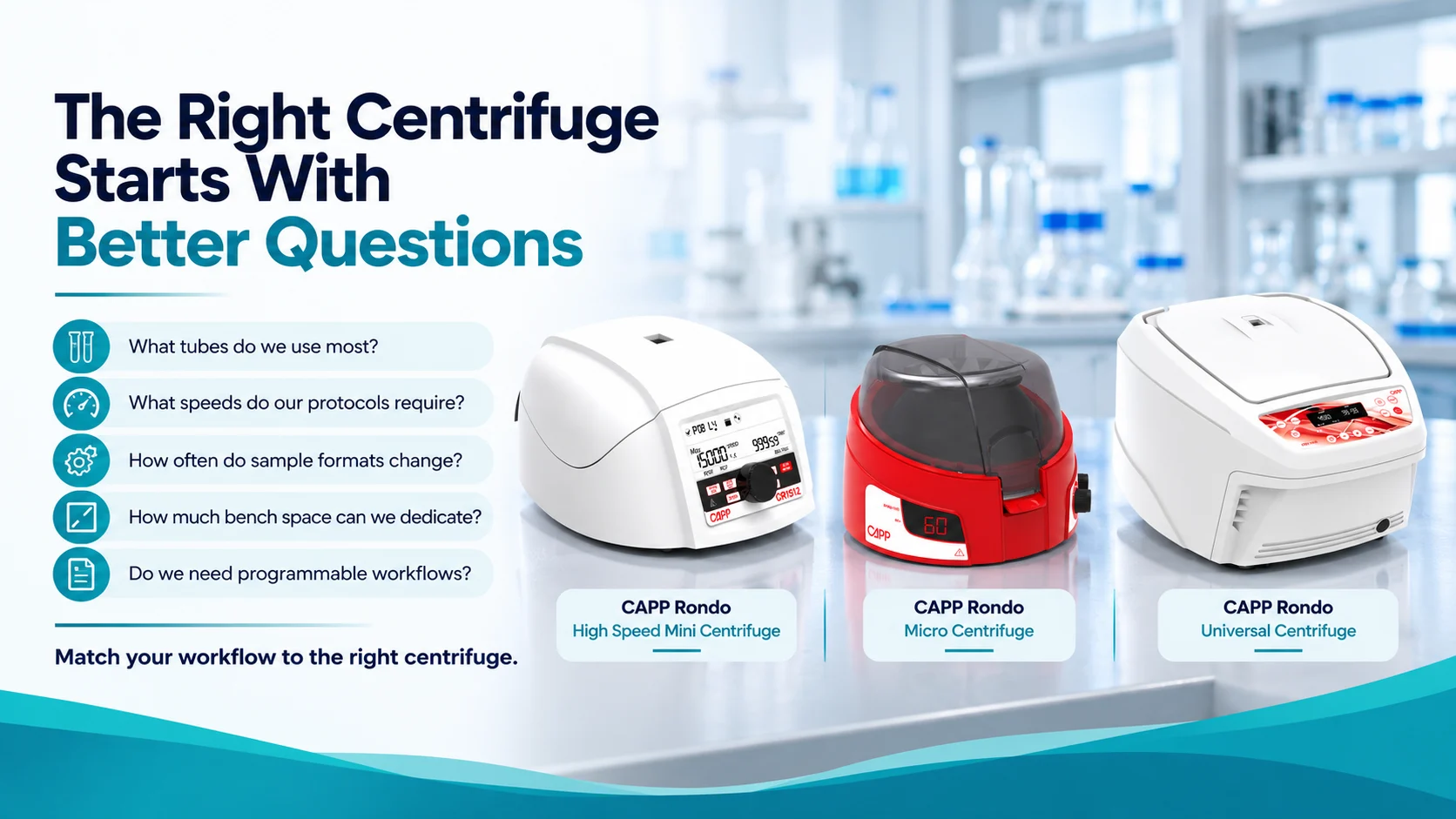
The Right Centrifuge Starts With Better Questions
Before selecting your next centrifuge, ask:
- What tubes do we use most?
- What speeds do our protocols require?
- How often do sample formats change?
- How much bench space can we dedicate?
- Do we need programmable workflows?
Those answers create a practical shortlist. Then specifications can confirm the decision. For small, high-speed applications, consider the CAPP Rondo High Speed Mini Centrifuge. For everyday microtube workflows, consider the CAPP Rondo Micro Centrifuge. For broader sample handling, consider the CAPP Rondo Universal Centrifuge.
Choose the Centrifuge That Fits Your Workflow
A centrifuge should solve a laboratory need. It should not simply add another instrument. Mini centrifuges suit compact, high-speed applications. Micro centrifuges suit everyday small-volume processing. Universal centrifuges support broader sample-handling requirements.
The best choice begins with understanding your workflow. AHN Biotechnologie offers CAPP Rondo centrifuge options for these different needs. Explore the range and match the configuration to your applications. Because the right centrifuge is not always bigger. It is the one that fits your laboratory best.
FAQs
1. Is a mini centrifuge suitable for PCR workflows?
It can be, depending on the required protocol. The CAPP Rondo Mini supports PCR strip rotor compatibility. It also reaches speeds up to 15,000 RPM.
2. What separates a micro centrifuge from a mini centrifuge?
Their capabilities and intended workflows differ. The CAPP Rondo Micro reaches 6,000 RPM.
The CAPP Rondo Mini reaches 15,000 RPM. The micro model focuses on routine small-volume processing. The mini model emphasizes high-speed sample processing.
3. When should laboratories choose a universal centrifuge?
Choose one when sample formats vary frequently. The CAPP Rondo Universal supports multiple rotor configurations. These cover several tube sizes and plates. That flexibility suits laboratories sharing centrifugation across workflows.
4. Should maximum RPM decide your centrifuge purchase?
Not by itself. RCF, rotor compatibility, capacity, and workflow matter too. Your protocol determines the useful performance range. A higher RPM does not automatically mean better results. The centrifuge should match the actual application.


