


Imagine your centrifugation run is almost complete. Then, you realise the sample temperature has climbed beyond the required range. You now have a separated sample, but can you trust the result?
For laboratories handling temperature-sensitive samples, this is more than an inconvenience. Uncontrolled temperature changes can affect how samples behave during processing. That can create uncertainty when consistency and controlled conditions matter.
This is where refrigerated centrifuges become crucial. Instead of choosing between separation and temperature control, laboratories can combine both. The right centrifuge can help maintain stable conditions while samples undergo demanding runs. This matters across clinical diagnostics, scientific research, and industrial laboratory work.
For laboratories handling different sample types, flexibility matters too. Tube sizes, rotor capacity, speed, temperature, and run time can vary. A centrifuge should therefore adapt to the protocol, not complicate it.
The CAPP Rondo Refrigerated Centrifuge from AHN Biotechnologie brings these requirements together. It combines refrigeration, high-speed centrifugation, interchangeable rotors, and programmable operation. So, where can refrigerated centrifuges actually make a difference? Let’s explore their key applications.
Why Use a Refrigerated Centrifuge?
Centrifugation uses centrifugal force to separate components within a sample. However, high-speed spinning can generate heat during operation. Temperature-sensitive samples may require controlled conditions during centrifugation. Refrigeration helps maintain a stable temperature throughout the run.
The CAPPRondo Refrigerated Centrifuge provides refrigeration down to -20°C. It also supports speeds ranging from 500 to 15,000 RPM. This combination makes it suitable for protocols requiring both separation and temperature control.
Applications of Refrigerated Centrifuges in Scientific Research
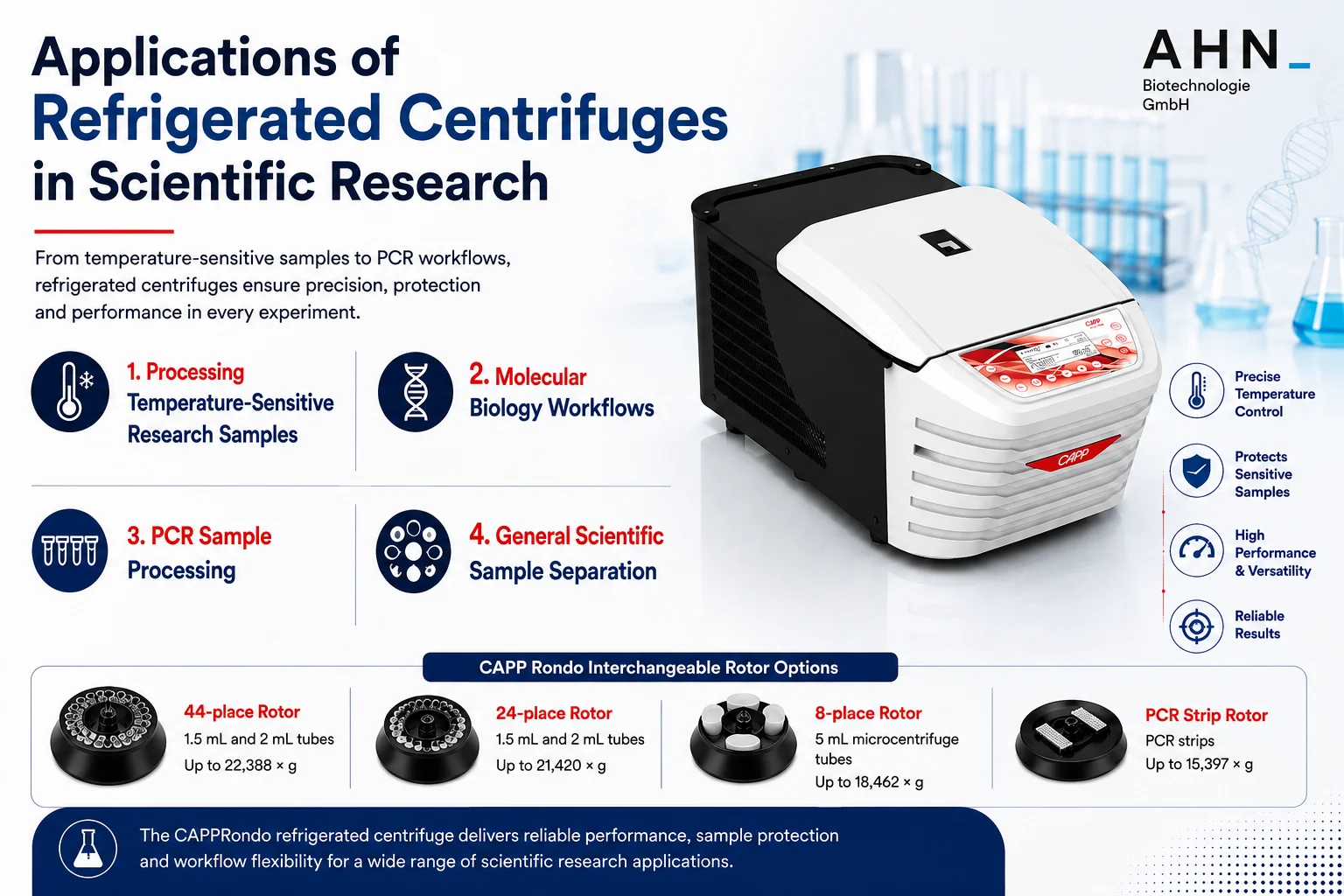
1. Processing Temperature-Sensitive Research Samples
Research laboratories often work with samples requiring controlled temperatures. Uncontrolled temperature changes can complicate sample processing. A refrigerated centrifuge provides temperature control during centrifugation. This makes it valuable for temperature-sensitive research workflows. The CAPPRondo maintains stable temperature throughout the run. Its built-in refrigeration system continues operating at high speeds.
2. Molecular Biology Workflows
Molecular biology laboratories frequently process small-volume samples. These workflows may involve microcentrifuge tubes and PCR strips. Rotor flexibility becomes important in these applications.
The CAPPRondo offers multiple rotor options:
- 44-place rotor: 1.5 mL and 2 mL tubes, up to 22,388 × g
- 24-place rotor: 1.5 mL and 2 mL tubes, up to 21,420 × g
- 8-place rotor: 5 mL microcentrifuge tubes, up to 18,462 × g
- PCR strip rotor: PCR strips, up to 15,397 × g
This allows laboratories to configure centrifugation around different sample formats.
3. PCR Sample Processing
PCR workflows can involve multiple samples and strip formats. Handling these efficiently requires compatible centrifugation equipment. The dedicated PCR strip rotor supports PCR strips directly. This gives laboratories another practical configuration for centrifugation workflows.
4. General Scientific Sample Separation
Not every research workflow uses the same tube or centrifugation requirement. Some need higher capacity. Others require different tube formats. The CAPPRondo addresses this through interchangeable rotors. Its speed range also supports different centrifugation requirements. Users can select speeds between 500 and 15,000 RPM.
Applications in Diagnostics
Research is not the only area where refrigerated centrifuges matter. Clinical and diagnostic laboratories also process samples requiring controlled conditions. Here, reliable operation and repeatable settings become particularly important.
1. Clinical Laboratory Sample Processing
Diagnostic workflows can involve repeated centrifugation throughout the day. Different protocols may require different speeds and durations. The CAPPRondo offers flexible time settings from 30 seconds to 999 minutes. It also supports infinite operation. This allows users to configure runs according to their established protocols.
2. Handling Different Diagnostic Sample Volumes
Diagnostic laboratories may work with different tube formats. A single rotor configuration may not suit every workflow. The CAPPRondo provides four interchangeable rotor options. This supports different tube and PCR strip requirements. That flexibility can help laboratories adapt the centrifuge to changing workflows.
3. Temperature-Controlled Diagnostic Workflows
Some diagnostic workflows require controlled sample temperatures during centrifugation. Refrigeration can help maintain stable conditions during processing. The CAPPRondo offers refrigeration down to -20°C. Its refrigeration system maintains stable temperature throughout the run. This adds temperature control without requiring a separate centrifugation setup.
What Makes the CAPPRondo Practical for Laboratories?
Applications are important. But daily usability matters just as much.
The CAPPRondo combines several features designed around routine laboratory operation:
- Large backlit LCD: Makes key operating parameters easy to adjust.
- 99 user-defined programs: Supports repeatable protocol settings.
- Brushless DC motor: Provides high-speed operation without maintenance.
- Imbalance detection: Helps support safer centrifuge operation.
- Lid-lock mechanism: Prevents access while the rotor spins.
- 43 kg frame: Provides stability during high-speed operation.
- Flexible timer: Supports runs from 30 seconds to 999 minutes.
Together, these features make the centrifuge adaptable across different laboratory requirements.
Choosing the Right Refrigerated Centrifuge
The right centrifuge depends on your workflow.
Before selecting one, consider:
- What sample formats do you process?
- What speeds does your protocol require?
- Do your samples need temperature control?
- How much rotor capacity do you need?
- Will you process PCR strips?
- How frequently will you repeat specific protocols?
These questions help match centrifuge capabilities with actual laboratory needs.
Bringing Temperature Control and Centrifugation Together
A centrifuge does more than spin samples. Its capabilities can directly shape laboratory workflows. When temperature control becomes important, refrigeration adds another layer of control. Rotor flexibility adds adaptability across sample formats. Programmable settings support repeatable operation.
The CAPP Rondo Refrigerated Centrifuge brings these capabilities together. From research workflows to diagnostic sample processing, it supports varied centrifugation requirements. With AHN Biotechnologie, laboratories can access a refrigerated centrifugation solution built around flexibility, control, and reliable operation.
FAQs
1. Why use refrigeration during centrifugation?
Refrigeration helps maintain stable sample temperatures during centrifugation. This is useful for temperature-sensitive laboratory workflows.
2. How cold can the CAPPRondo Refrigerated Centrifuge operate?
The CAPPRondo can provide refrigeration temperatures down to -20°C.
3. Can the CAPPRondo handle PCR strips?
Yes. It includes a dedicated PCR strip rotor. The rotor supports speeds up to 15,397 × g.
4. How many centrifugation programs can be stored?
The centrifuge supports up to 99 user-defined programs. Each program can contain four lines.
5. What tube sizes can the CAPPRondo accommodate?
It supports 1.5 mL, 2 mL, and 5 mL microcentrifuge tubes. It also accommodates PCR strips using the dedicated rotor.
